.png?h=455&iar=0&w=1182&rev=d74e300da7ba4627bde32b9c768419b5)


Resource Article
What Is a Fire-Rated Door? Understanding Ratings, Materials, and Requirements
Key Takeaways:
- A fire-rated door is a tested door panel and frame that requires additional fire-rated components to create a full assembly that is designed to help slow the spread of fire and smoke for a specific amount of time.
- Fire-rated doors are most commonly required in homes between an attached garage and the living space, though requirements vary by local code.
- Renewal by Andersen's Ensemble® fire-rated door is UL certified as a complete assembly, rather than relying on individually certified parts installed correctly in the field.
Every year, garage fires cause an average of $457 million in property loss across the U.S. Garage fires also tend to spread larger and farther than fires that start inside the home—which is exactly why so many building codes require fire protection* between an attached garage and the rest of the house.
If you're here because a code official, home inspector, or contractor mentioned you need one, you probably have some real questions: What actually is a fire-rated door? How is it different from the door you already have? And how do you know if a specific product meets the requirements for your home? Let's walk through it.
What Is a Fire-Rated Door?
You'll often hear these called 'fire doors'—that's perfectly acceptable. We'll use 'fire-rated door' here since it's a more precise industry term.
A fire-rated door has been engineered and independently certified to help resist the spread of fire and smoke for a specific period of time—typically measured in minutes. That might sound like a simple upgrade, but a true fire-rated door goes through rigorous testing to earn the name.
It’s also important to clarify what "resist" means here. No door is fireproof, and a fire-rated door doesn't claim to be. What it does is help buy some time by helping slow a fire's progress and help provide assistance holding back smoke long enough to help people to get out safely. That's the real purpose behind the rating number you'll see throughout this article: it's a countdown on it's a safety precaution measured in minutes added to the amount of time you have to escape from a fire, not a guarantee that the fire won't eventually get through.
What is a fire-rated door made of?
Fire-rated doors are built from a range of materials, depending on the manufacturer and rating, including solid wood, steel, and composite cores. Many use dense, fire-resistant fill material housed inside a durable outer skin such as steel or fiberglass.
What matters most isn't any single material by itself, but how the complete door-and-frame assembly performs when tested as a unit. That's also why swapping out hardware, adding hardware not approved for the assembly, or doing anything else that alters the system can void its certification.
How Does a Fire-Rated Door Work?
At a high level, a fire-rated door contains certified parts that are designed to work as a system to help contain flames, block toxic smoke, and help compartmentalize the fire. The basic components that allow this to happen are:
- A door panel made with fire-resistant mineral or solid wood
- A door frame made of steel or solid wood
- Heavy-duty hinges that keep the door aligned under extreme heat
- A self-closing device, like a mechanical closer or spring hinge that automatically shuts the door
- A latching mechanism that keeps the door tightly shut during a fire
Fire-rated door certification: Individual component vs. complete assembly
Many fire-rated doors on the market are made up of individual components that are independently tested and certified—the door, the frame, the hinges, and the latch—to achieve their rating.
That's a valid path to compliance, but it depends entirely on every piece being installed correctly in the field. If a component is swapped, modified, or installed incorrectly, the fire rating for the whole opening can be compromised without anyone realizing it until it matters most.
To be clear, when you purchase a fire-rated door based on individual component certification, you're really only getting the fire panel and fire frame. The special hardware and hinges are additional parts that you purchase separately.
A door certified as a complete assembly, like our Ensemble® Fire-Rated Door, works differently. The entire system is tested and certified as one unit—panel, frame, hinges, and hardware together. That removes a layer of installation risk, because you're not relying on separately rated parts coming together correctly on site. However, it does illustrate why it’s critical to follow the installation instructions.
Overview of Fire-Rated Door Performance
A fire-rated door's "rating" tells you how long it's been tested to withstand fire exposure before it becomes compromised, and it's the number that determines whether a specific door meets your local code requirement for your application. Ratings are established through standardized testing (in the U.S., commonly UL 10B and UL 10C**) where a door assembly is exposed to controlled heat and, afterward, a hose stream test to simulate real firefighting conditions.
Here's a quick reference for common ratings† and where you'll typically see them required:
- 20 minutes: Attached garage-to-home doors (most common residential requirement)
- 45-60 minutes: Stairwells, corridors, and some multi-family separations
- 90 minutes: Higher-hazard commercial or industrial openings
- 180+ minutes: Specialized industrial or high-hazard applications
Local codes vary, so the rating you actually need depends on your specific situation and your local code requirements. This list is a general reference point, not a substitute for checking with your municipality.*
How to read a fire-rated door label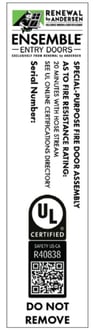
Every certified fire-rated door includes a unique permanent label, usually a small metal or foil tag that verifies its rating and certification.
Here's what to know and why it matters:
- What it includes: A certification mark (such as a UL stamp), the door's fire-resistance rating, and often a QR code or serial number linking to product-specific certification details.
- Do not remove it: This label serves a critical purpose. It's proof that your specific door meets code. Removing, painting over, or damaging it can make it difficult to verify compliance later, such as during a home sale or insurance inspection.
- It can't be transferred: A label is specific to the door it's applied to and can't be reused on a different unit.
If you're ever unsure whether an existing door in your home is fire rated, this label is the first thing to check.
When Do You Need a Fire-Rated Door?
The most common residential requirement is between an attached garage and the home—building codes require protection here because garage fires are both frequent and prone to spreading quickly into living spaces. According to Chapter 3, Section R302.5.1 of the International Residential Code, that opening must be protected by one of three options:
- A solid wood door at least 1-3/8 inches thick
- A solid- or honeycomb-core steel door of the same thickness
- A 20-minute fire-rated door
Whichever option is used, it must also be self closing. So, a fire-rated door isn't the only path to compliance, but it's a common and reliable one, especially if you want documented, labeled proof for an inspection, insurance review, or home sale.
Fire-rated doors also show up in other settings, like multi-family buildings (between units, or in shared hallways and stairwells) and commercial spaces, where requirements are typically more extensive. If you're a single-family homeowner without an attached garage, you may not have a code requirement for one at all.*
It's important to note that there is not one specific governing body that determines these codes across the country. However, there is guidance that comes from the International Residential Code and most states in the US enforce this guidance or use it as a baseline. However, a small minority of states do not enforce a single mandatory statewide code but instead leave IRC adoption up to individual counties and municipalities.
The Ensemble® Fire-Rated Door from Renewal by Andersen
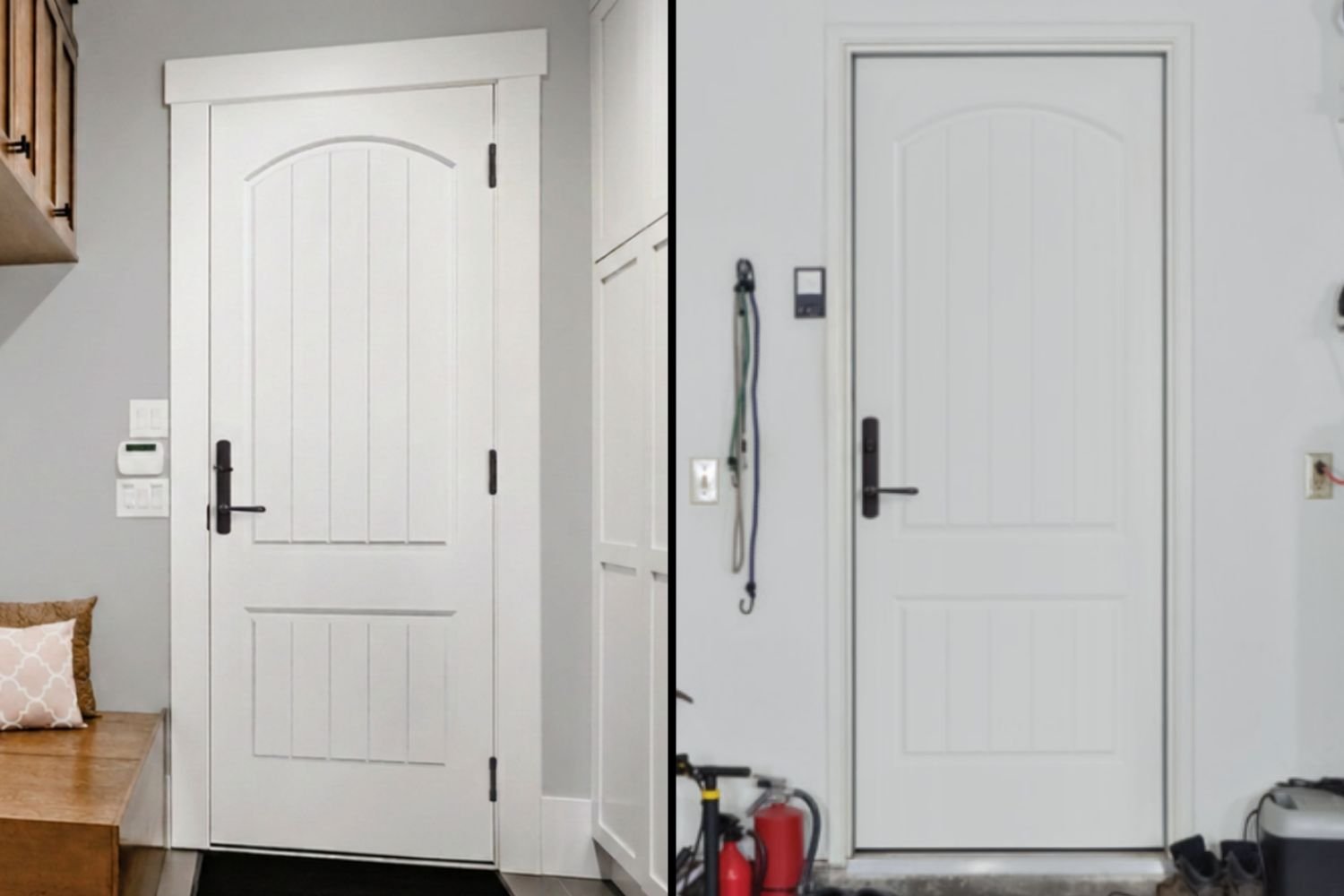
Renewal by Andersen's Ensemble® fire-rated door is certified as a complete assembly. It combines the stylish design you know and love from our standard Ensemble entry doors with advanced safety features that provide extra protection in the event of a garage fire.
What makes the Ensemble Fire-Rated Door unique?
A few specific engineering details make the assembly certification possible and set the Ensemble fire-rated door apart from the standard entry door.
- Intumescent strips: Two integrated intumescent strips are located within the door head jamb. This unique, patent-pending design resists fire penetration, with the strips expanding up to 100 times their original size during a fire to help seal the opening.
- Self-closing hinges: The Ensemble fire-rated door is equipped with UL Class 1 certified self-closing hinges that close the door behind you. Rated for one million cycles, these durable, patent-pending hinges are fully adjustable and designed to provide years of trouble-free operation.‡ Four finish options make it easy to complement your door hardware.
- Panel filler: The door’s panel core is constructed with hardwood stiles and rails, and a dense cellulose composite fill known as Agrifiber. Together with the tough fiberglass skin, these proven materials help provide a strong, fire-resistant door panel.
Because of the specific requirements for certification, Ensemble® fire-rated doors are currently available in single-door configurations without glass options. They come in three different styles with durable, solid-color coating options to help them look better and last longer.§
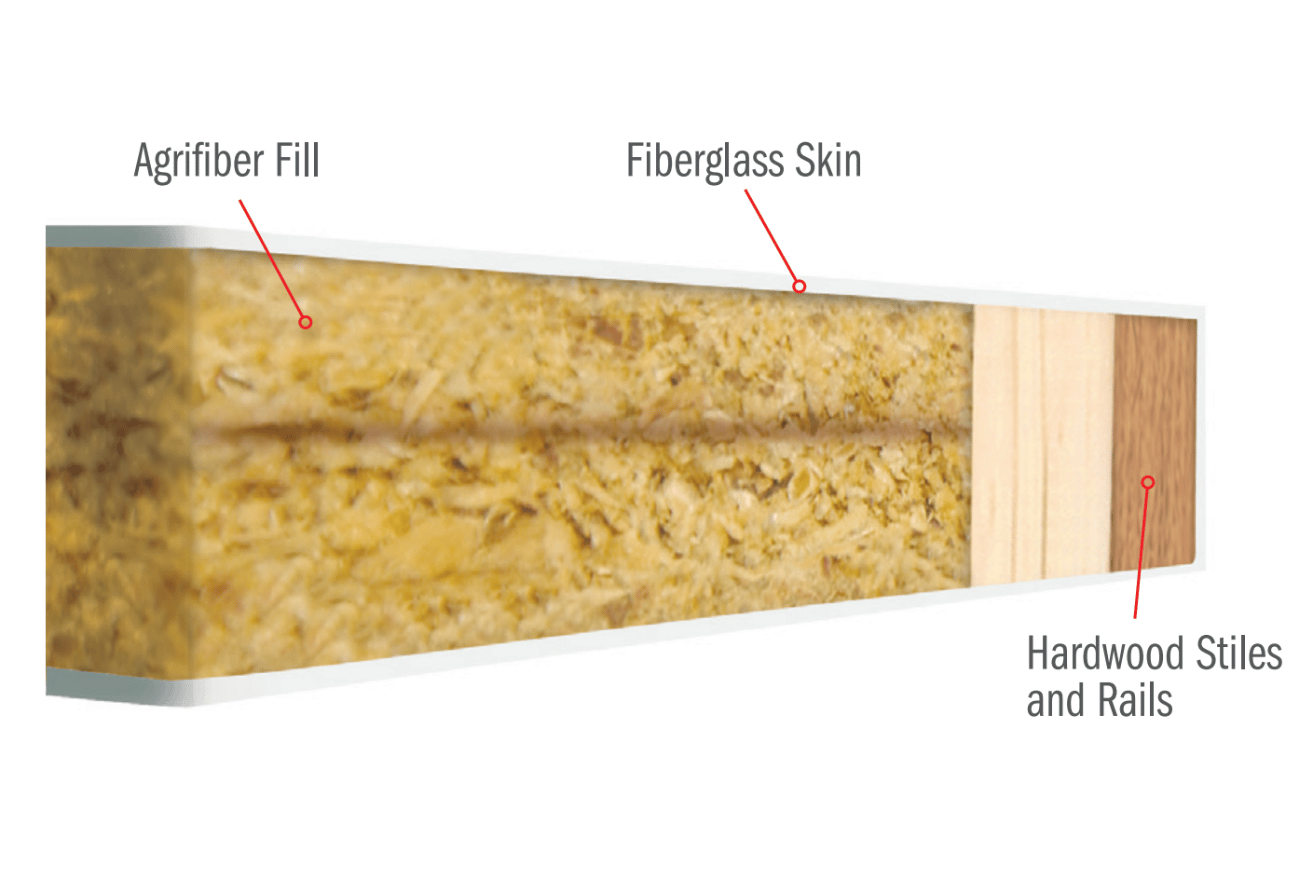
Inside view of an Ensemble Fire-Rated Door's panel core.
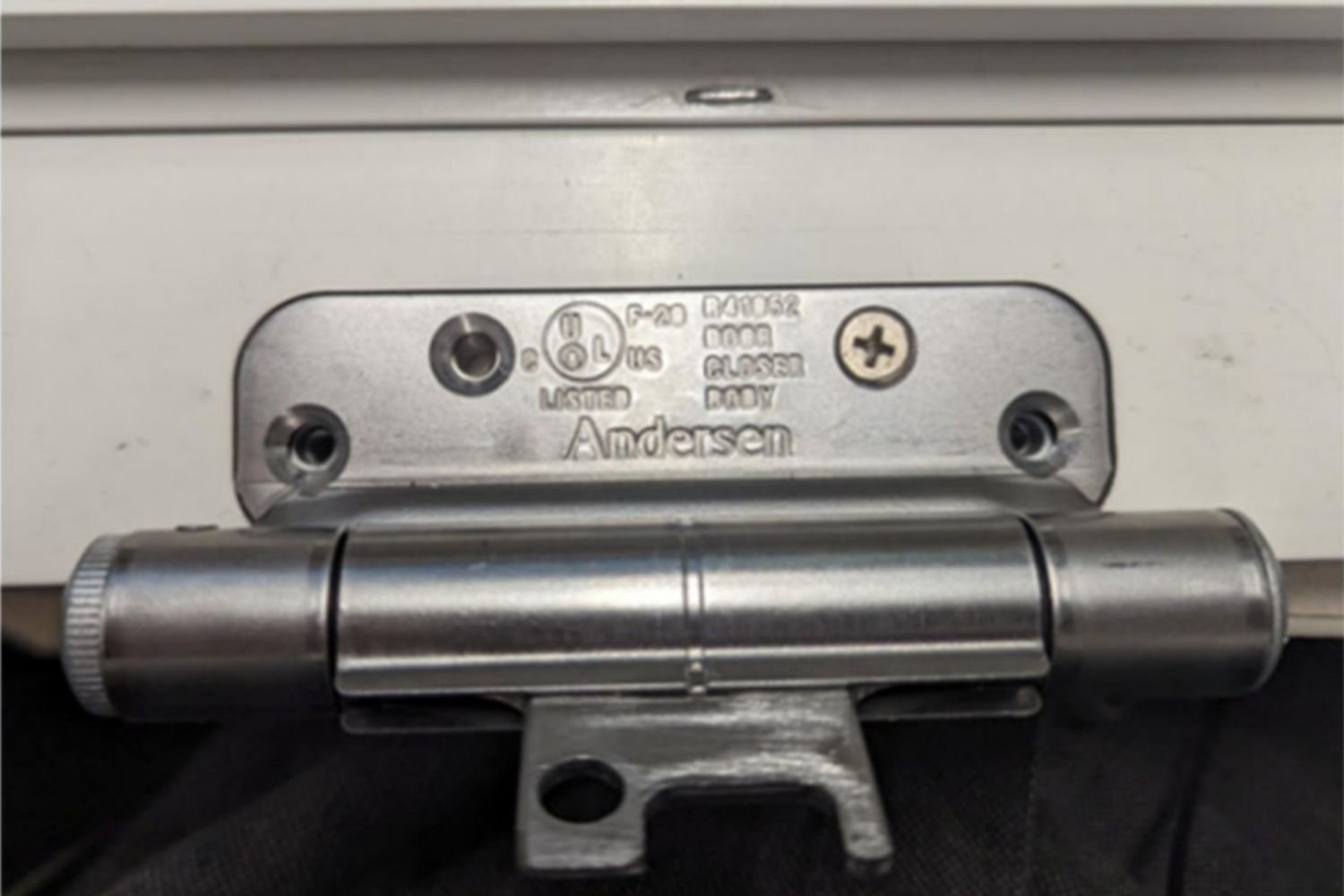
Renewal by Andersen UL Certified Class 1 self-closing door hinge.
Renewal by Andersen UL Certified Class 1 self-closing door hinge.
Codes, standards, and certification: Is it right for my home?
Ensemble fire-rated doors are certified under UL category GSXZ (Special Purpose Fire Doors) and tested to UL 10B, UL 10C, and NFPA 252—the same standards referenced in the ratings list above—earning a 20-minute fire rating.**
Here's a quick way to think about fit:
- Likely a strong match: You have an attached garage, live in a jurisdiction that has adopted the IRC (as most US states have), and want a fire-rated door with the same look and finish options as a standard entry door.
- Double-check first: Your local code has a stricter overlay than the IRC baseline (some states and municipalities require longer ratings or additional hardware), or you're in a commercial or multi-family setting outside typical single-family use.
Frequently Asked Questions
Where is a fire certification label located?
On most fire-rated doors, including Ensemble fire-rated doors, the certification label is located on the hinge side of the door panel. It should remain visible and untouched for the lifetime of the door.
Where are fire-rated doors required?
Most commonly, fire-rated doors are required between an attached garage and the home. They're also commonly required in multi-family buildings and commercial spaces, particularly in shared hallways, stairwells, and unit separations. Requirements vary by jurisdiction, so it's best to confirm with your local building code official.*
What makes a fire-rated door different from a standard door?
A fire-rated door is engineered and independently tested to help resist fire and smoke for a specific amount of time. A standard door has no certification or fire-resistance rating. It is usually designed for durability, insulation, and curb appeal, not for slowing fire spread in an emergency.
Find the Right Fire-Rated Door for Your Home
If you have an attached garage and aren't sure whether your current door meets code, schedule a free consultation with a Renewal by Andersen design consultant. They can help you figure out what your home needs and whether an Ensemble® fire-rated door is the right fit—no pressure, just a straight answer.
* Codes may vary. See your local code official for code requirements in your area.
** Standards: UL 10B, UL 10C. Test details and data available at https://markshub.ul.com/products/5120
† According to the International Building Code, Chapter 7, Sections 716.1 and 716.2. Specifically, see table 716.1(2) Opening Fire Protection Assemblies, Ratings and Markings.
‡ See Renewal by Andersen® Products and Installation Transferable Limited Warranties for details.
§ See the limited warranty for details.
Our Hassle-Free Process

Step 1
Design Consultation
Step 2
Measure and Manufacture
Step 3
Installation
Step 4